
In 2022, the city of Houston had a problem: too many cars. Like many cities across the country, it was nearly impossible to get anywhere without one. To combat this, city officials introduced “Vision Zero,” a plan to track traffic incidents, educate the public about road safety and increase walkable infrastructure. In January, New York City tackled a similar problem by introducing congestion pricing, which charged drivers more to drive in the city during times of peak traffic. Those behind the project hoped it would reduce traffic and raise money to improve transit systems, in addition to reducing traffic fatalities.
These initiatives, along with many others, attempt to address the lack of walkability in cities across the country. This situation is not universal. Outside the United States, walkable cities thrive. A study in the Nature Cities journal calls these “15-minute cities,” since most places that residents need to travel to can be reached within 15 minutes. Of the 50 most walkable cities in the world, 45 are in Europe. Cities in Taiwan, Nepal and Japan also appear. No American cities make the list.
Big Rapids, with a walkability score of 39 out of 100, has consistently struggled due to one major factor— construction. The city is in the midst of a Capital Improvements Program that will last until 2028. As a result, construction has been nearly continuous since the program’s start in 2022. The 2025 construction plan alone had more than 15 projects in it.
In 2024, the city introduced plans to “improve the non-motorized connectivity within the community,” according to Community Development Director Michelle Stenger, through additional sidewalks in key areas. Mayor Fred Guenther voted no on this plan.
While some areas, such as the Big Rapids Riverwalk, cater to pedestrians, many more do not. With such car- focused infrastructure, attempts to improve vehicle throughput take precedence over, and often negatively impact, pedestrian accessibility. This problem extends across the country, with walkable areas in the United States making up only 1.2% of metropolitan land area. Efforts to solve these problems are increasingly difficult.
In 2024, Houston’s new mayor indicated that he was pulling back on support for Vision Zero. In February, President Trump shared on social media that New York’s “”CONGESTION PRICING IS DEAD. Manhattan, and all of New York, is SAVED.”
Why is it so difficult for American cities to increase walkability?
When America’s network of highways began in 1956, cars were a sign of freedom. Driving a car meant people could travel further, and do so faster, than ever before— better yet, they could do so without relying on anyone else to get them there. Cities expanded, people got comfortable traveling further on a regular basis and development of public transportation was stunted.
Public transportation is an important factor in “15-minute cities,” and is now seen as an important piece of a functioning city, though newer attempts to introduce it now have to compete with existing infrastructure. This often means it’s harder to reinvent a city as walkable than it would have been to make it walkable to begin with. As new structures are approved, they get constructed in between and top of preexisting building projects, each with unique regulations, safety standards and bureaucracy to follow. This is why Houston’s “Vision Zero” plan had a price tag of nearly $30 million, and why many programs like it are cancelled.
This leaves college campuses as seemingly the closest thing America has to a walkable city. Since campuses are, in many ways, self-contained communities, students can make a choice they often wouldn’t otherwise have— to not use their car.
Ferris State University, in its 2021 master plan, labeled its campus as “an easily ‘walkable’ campus,” and even has a walking tour. The plan adds that the “vehicular network should be secondary to the pedestrian.” Many students take advantage of this opportunity.
I walk everywhere,” said Trever Kacyak, a member of Ferris State University’s Way for Life Program. “Campus, and my apartment, and my class.”
Ferris State University also has a shuttle service that takes students between parts of the campus, an example of sustainable public transportation. Their longer-range bus with service to Cedar Springs and Grand Rapids, though, can sometimes be up to 30 minutes late to arrive.
“Before I transferred here, I used to go to school in Chicago, so I know public transportation is very important. And walking was also a great option, because it’s more convenient,” said Gabin Goodrich, a Digital Animation major at Ferris State University.
Goodrich added that living in a walkable area allows people who don’t have a car to get around more easily.
“I think (walkability) is really important for us,” Kacyak said, adding that increased walkability reduces the amount of traffic in a community.
Traffic is something many advocates of walkable communities point to. Research found that the average driver spends the equivalent of nearly 2 days a year in traffic, and a single vehicle can produce 4.6 metric tons of carbon dioxide in a year.
Psychology major Karley Kowalewski chooses to walk to class, to avoid parking tickets.
“I think (walkability is) a huge factor for a lot of people, especially because in your early years, you’re living on campus, and that means you have to walk’” said Kowalewski.
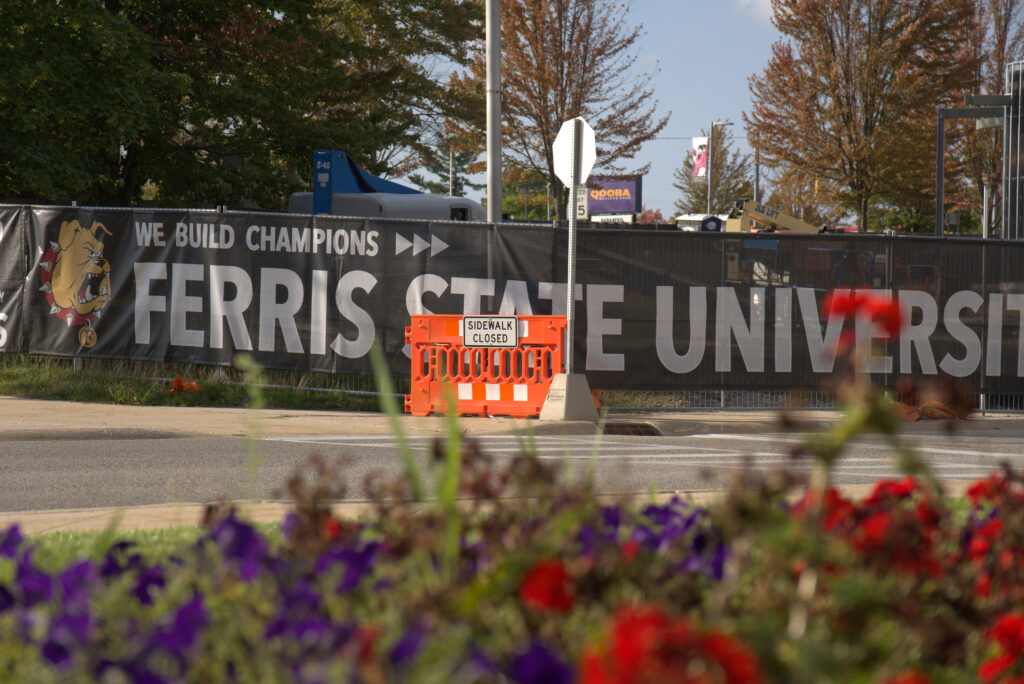
Frequent construction impedes walkability on campus, too. Ferris State University recently started building its Jim Crow Museum, the construction of which blocks part of the sidewalks nearby. This comes after a long pattern of frequent construction projects on campus during the school year, and as classes are moving into newer buildings while further buildings are being constructed
This construction is “very frustrating, if it’s blocking people’s routes to class,” according to Goodrich.
“(Construction) makes the walking a lot more annoying, especially with all of the noise. And then, there are certain areas closed, and it causes a lot more traffic, which can cause your walking to take longer,” said Kowalewski.
Despite the structural diversity of America’s communities, one thing remains the same— cars are overwhelmingly the default mode of transportation, and Americans increasingly take issue with that. In a system so entrenched in existing infrastructure, though, adding alternatives often requires dismantling what already exists, a costly and difficult endeavor. As cities adjust budgets and advocates push for change, only time will tell who will ultimately get the right-of-way.