
Joshua Begian-Lewis, who uses they/them pronouns, is the newest addition to the Jim Crow Museum and has been serving as the museum’s assistant for over a month.
Begian-Lewis plays a vital role at Ferris by supporting the Jim Crow Museum’s mission to educate and inspire. Through their organizational skills and commitment to meaningful work, they help preserve history, promote understanding and ensure that this powerful resource continues to impact students and the broader community.
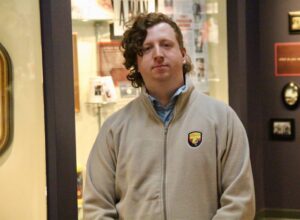
After years in high-pressure corporate roles, Begian-Lewis sought a more meaningful path. Disillusioned by the profit-first mindset of logistics, they chose to leave that world behind and bring their skills to Ferris, where purpose and impact now guide their work at the Jim Crow Museum.
“I wanted to be part of something important and good,” Begian-Lewis said. “What I enjoy the most is just knowing it’s an important message.”
Begian-Lewis didn’t follow a traditional academic path. While they began college, work demands eventually led them to focus on hands-on roles, including time as a nuclear pharmacy technician and an emergency dispatcher, which are jobs that demanded precision, patience and resilience. Later, they transitioned into logistics, managing contracts and building data systems from the ground up.
“The whole point of a degree is training in a skill, and I had those skills and experience within data management, spreadsheets, and running databases, but not the degree to prove it,” Begian-Lewis said. “I’d get rejected for jobs I was overqualified for within 15 minutes. It was frustrating. I think more places need to look at what someone can actually do, not just what’s on paper.”
Though their work often happens behind the scenes, Begian-Lewis plays an essential role in the daily operations of the Jim Crow Museum. As the museum assistant, they serve as the first point of contact for visitors and inquiries, coordinate group tours, schedule traveling exhibits and help process donations. They also act as a docent when needed and handle various office administration duties that keep the museum running smoothly.
But even in these logistical tasks, Begian-Lewis sees the bigger picture. Preserving the past to educate the future.
“A lot of people don’t know what happened in that period,” Begian-Lewis said. “There was literally a student who walked by and asked, ‘Who is Jim Crow?’ It shows how important this work still is.”
While Begian-Lewis was drawn to the museum’s mission, their decision to join Ferris was also deeply personal. Their spouse was hired as a professor around the same time, and although they work in different departments, being part of the same campus community has made the transition especially rewarding.
“We don’t work closely, not even in the same department, but it’s worked out really well,” Begian-Lewis said. “It’s nice to be in the same place, and we even get to have lunch together most days.”
Although this job is the start of a new beginning, they aren’t chasing a title or promotion. They’re looking for a stable community like Big Rapids to call their home. After years of instability, they’re hopeful Ferris will be a long-term home.
“Every job I’ve had, I just wanted to find a place to settle in,” Begian-Lewis said. “And I think I finally have.”
After years of navigating an unpredictable career path, Begian-Lewis has finally found more than just a job; they’ve found a sense of purpose, a community and a place to belong.
For students and professionals alike, their story highlights the importance of resilience, adaptability and staying true to what matters most.
“Don’t let rejection beat you down,” Begian-Lewis said. “The world can be stressful, but there’s a role out there for everyone. You just have to keep pushing and trust that you’ll eventually find the right fit.”
With a new facility expected to open in Fall 2026, the Jim Crow Museum continues to grow and rebrand in a direction that has the potential to reach new audiences and spark meaningful dialogue, staying true to its original mission.