
The 32 Court Community Connections program brought the Michigan Supreme Court to Big Rapids High School on Wednesday, Oct. 15, for the case of People of MI v Freddie Wilkins, III.
The event began at 9:30 a.m. with students from Ferris State, along with 11 other high schools and middle schools from the area, including Big Rapids High School, hearing the case against Freddie Wilkins, III. in the Big Rapids High School auditorium.
This marks the second time that the Michigan Supreme Court has visited Big Rapids as part of the Court Community Connections, founded in 2007, a public education program aimed primarily at high school students. Big Rapids is just one of two cities visited twice, the second being Ann Arbor.
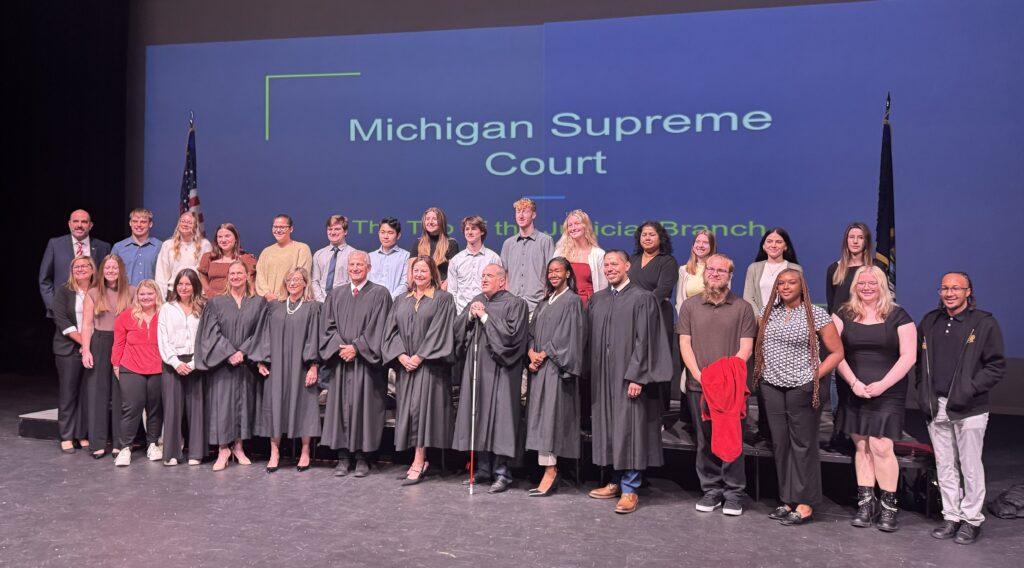
After a student briefing by Chief Operating Officer Daniel Brubaker and Chief Commissioner Cheryl Nowak explaining the facts of the case, students were welcomed and heard a performance by the Big Rapids High School band.
Chief Justice Megan Cavanagh gave the opening remarks before oral arguments were heard, followed by opportunities for questions and pictures with the justices.
Cavanagh says that reaching rural areas is something the Michigan Supreme Court is very conscious of. Reaching students in areas referred to as “legal deserts” is something especially important.
“I think programs like this, you may not be able to get up to Lansing and come into the court, you know in the middle of the day, on a random Wednesday or Thursday. But when we can come to you, and show you what that is and the people here, like our commissioners and the attorneys, spend the time to really sort of show what it’s like to be a real person practicing and doing these jobs. I think it’s really important.” Cavanagh said.
This sentiment is shared by business law professor Emily Fransted, who typically takes LLaw 160 students to the Michigan Supreme Court in Lansing.
“When we go to Lansing, it takes up almost an entire day. Here, students are able to, many of them using their own transportation, participate in the morning session, participate in a Q & A with the justices afterwards, have photographs with the justices, which is something that we have not been able to do when we travel to the Michigan Supreme Court,” Fransted said.
Fransted was presented with a resolution from the Michigan Supreme Court by Cavanagh before the hearing.
The opportunity to hear the arguments provided students a lot of insight into what real-world appellate cases are like. For business senior Alexis Whitebread, this was the first opportunity to hear a case.
“I’ve never seen any hearing like this, and it was really cool to have my first be the Michigan Supreme Court,” Whitebread said. “It was definitely interesting to see them, just sitting in folding chairs and folding tables on a stage, but it was still really cool to see.”
For many middle school and college students alike, this was an introduction to the legal process, but for criminal justice junior Ayden Hewer, it was confirmation.
“I’ve kind of known for a long time that I want to go to law school, but seeing another court case, because I’ve seen a couple, and the way that it’s not like how TV portrays it. That kind of helps my decision,” Hewer said. “I’d say that it probably helped my decision that I want to go more.”
Following the oral arguments, students were able to ask both attorneys questions as the justices deliberated. A reception was held after, giving students an experience that business professor Aaron Madziar described as “once in a lifetime.”
“Going to Lansing is great in its own way, it’s very impressive to see the Hall of Justice and to see the formalities of it all, but having the justices here gave students an opportunity to meet them, to talk about career goals, to get advice, to just personalize them,” Madziar said. “I think this is a great way for students to meet with the justices and meet with people at the highest level of our judicial system and hear advice and insight that helps them make better decisions. It’s pretty incredible to get to talk to these people one on one.”
Students were able to mingle with the Michigan Supreme Court justices and the attorneys, along with Mecosta–Osceola County Judges and local attorneys. Students were able to ask further questions about the case, law school and the court process. Students were encouraged to ask about job shadow opportunities.
For Fransted, this time to mingle was vital for students to see the bigger picture.
“I want students to walk out of this with an understanding of where this decision on these specific facts has the potential to impact all sorts of traffic stops that are going to happen after this case is decided,” Fransted said.
The results of the oral arguments are pending and will likely be released in a few weeks by the Michigan Supreme Court.