
As a result of the federal government shutdown, SNAP benefits have officially been paused.
While the WIC program remains operational for now, it is at risk of being halted if the shutdown continues.
The pausing of federal programs, such as SNAP, poses a risk to many people who depend on it to access food for themselves and their families.
As of Friday, Oct. 31, a federal judge ordered the Trump Administration to continue paying for food stamps using emergency funds amid the shutdown. However, it is unclear whether recipients will receive full benefits and when the funds will be distributed, as the fund may not be able to cover the full cost.
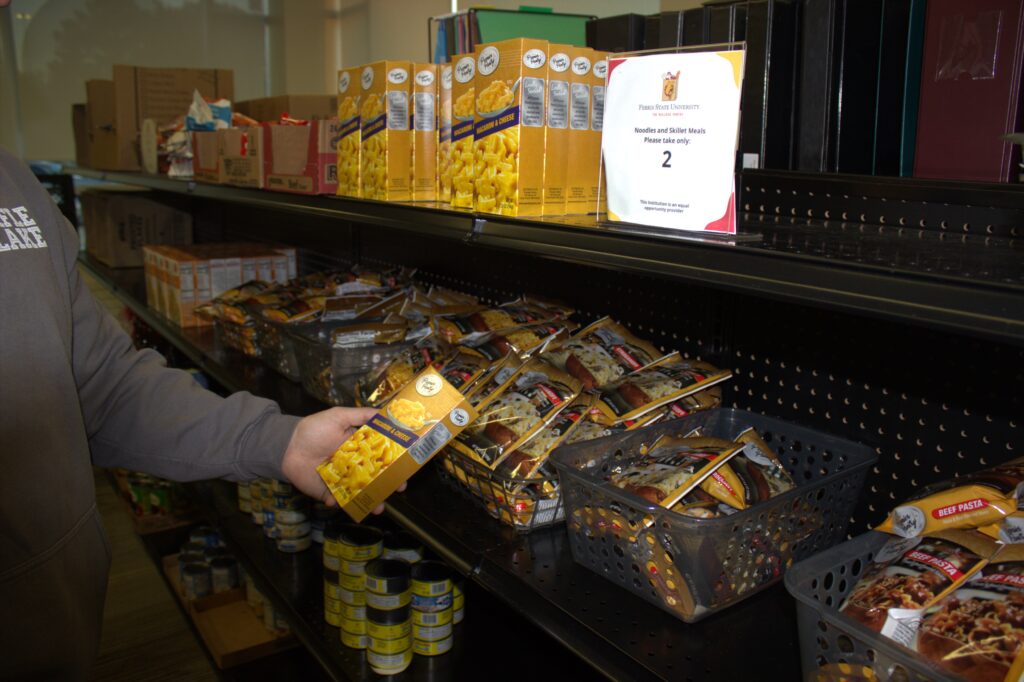
This situation leaves over 41 million Americans at risk of not having access to food. There has already been an increase in the number of people utilizing food pantries, even on campus.
Josh Olszewski, the Student Organization and Greek Life Coordinator, is the overseer of the Bulldog Pantry, which assists students on campus facing food insecurity.
Olszewski discussed how the government shutdown may impact students on campus who are facing food insecurity and shared a little bit about how the pantry operates.
“I think we’re going to see a lot more students utilize the pantry,” Olszewski said. “We already have in the last couple of days. The pantry is open to all enrolled students, and we don’t make students prove their need, so they just come in, fill out a form, and they can shop and get the items they need.”
Megan Somsel, the Basic Needs Care Coordinator, helps students facing basic needs insecurities, including food insecurity, housing, medical technology and more. Somsel shared about her recent experiences with students amid the shutdown.
“I have actually been seeing some students reach out in the last couple of days, as well as saying that they’re worried about their SNAP benefits ending,” Somsel said. “I try to connect them with additional community resources as well.”
Somsel frequently directs students to resources such as the Bulldog Pantry, the West Campus Community Pantry, Mana Pantry, Project Starburst, mobile pantries and local churches that provide weekly meals.
These resources can be useful to students who are struggling with food insecurity, which has increased as a result of SNAP benefits being threatened.
Kavaris Sims, the Associate Dean of Students, oversees the Office of Community Standards and case management efforts related to basic needs and care support.
Sims discussed the impact he believes the shutdown will have on students, as well as his belief that Ferris is prepared to handle situations like this one.
“It’ll have a significant effect. I think we have pretty much gone into overdrive to prepare ourselves,” Sims said. “Our job is to make sure we’ve prepared for it.”
While many students are currently fearful of how they are going to ensure they have access to food and other basic needs, the faculty involved with Ferris’ many support teams are working tirelessly to mitigate fear and provide for students’ needs.
Sims offered some words of encouragement for students who are facing challenges relating to food and other basic needs insecurity.
“We try to normalize it. It’s okay to struggle. We all have challenges; some people in academics, and some people have challenges with food insecurity, right? We want to normalize it and make sure that you feel comfortable reaching out to somebody for help,” Sims said. “We’re Bulldogs looking out for Bulldogs, and that’s all we try to do.”
Many students on campus struggle with a variety of issues throughout their time on campus, and are encouraged by faculty to reach out for help when they need it.
Somsel talked about her experience working with students facing food and basic needs insecurity in hopes of decreasing the stigma surrounding such challenges.
“I always tell [students] that everybody, at some point in their life, experiences some sort of challenge like this. Everybody’s been there,” Somsel said.
Olszewski concluded by explaining how common it is to face challenges when it comes to being in need, as well as providing comfort to students in this situation.
“You’re not alone, and basic needs and security is a spectrum that a lot of folks are on somewhere,” Olszewski said. “That’s why we’re here, and we have a whole team to support students.”
The Bulldog Pantry is currently open Monday and Tuesday from 1 to 6 p.m. and Wednesday and Thursday from 2 to 7 p.m. It is located in the David L. Eisler Center near Starbucks and is open to all currently enrolled Ferris students.