
Students at Ferris State University will soon be able to check out more than books from FLITE, including air fryers, jumper cables and even cornhole sets.
Starting after spring break, the library will initially offer a variety of kitchen and cooking items, featuring an air fryer, crock pots, pots and pans, frying pans, sauce pans and even a mixer. Practical items will also be included, like jumper cables, an iron, and an ironing board, along with tools like screw driver sets, wrenches and socket sets.
Students will be able to check out items at the FLITE circulation desk in the same way they would borrow books or laptop loaners. Before taking an item, borrowers will be required to sign a waiver agreeing to use the equipment properly and return it in good condition. Most items will circulate for one week at no cost. Fees will only apply if an item is returned damaged, excessively dirty or not returned at all.
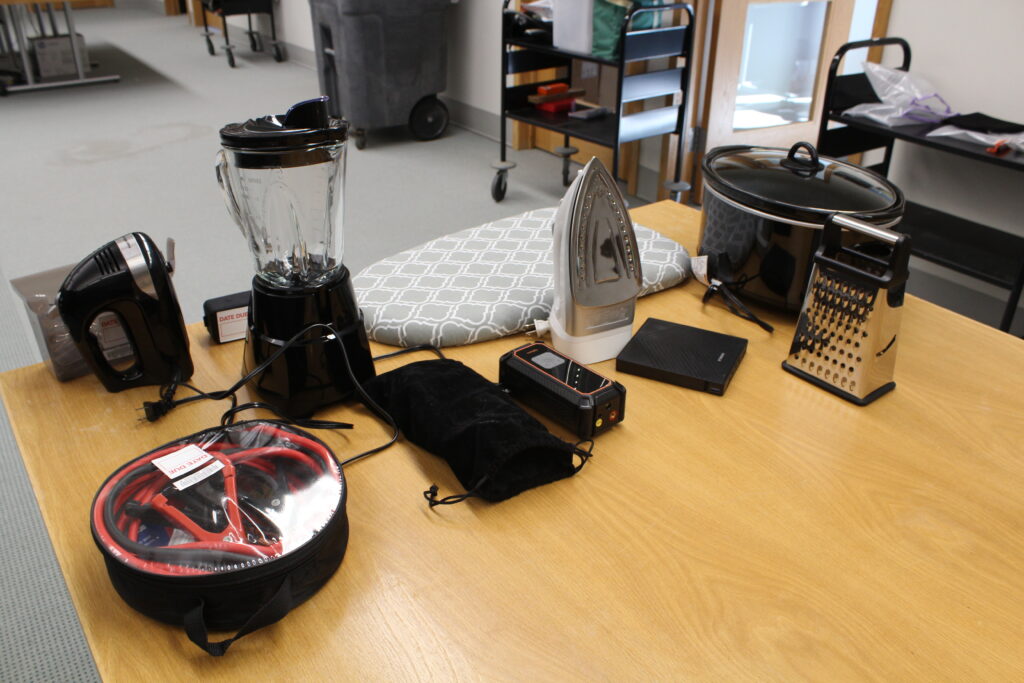
This collection is meant for students and faculty on campus and is meant to encourage community borrowing, lending and sustainability within the campus community.
Student engagement librarian at FLITE, Lauren Vogt, was one of the people involved with the creation of this new project. Since this is the first phase of the project, the initial collection will act as a way to gauge what is actually being borrowed. Vogt mentioned how this idea was meant to coincide with the Bulldog Food Pantry on campus.
“We had thought in terms of, of places the Bulldog Food Pantry opening up and being a food resourcing place on campus, and that food insecurity is pretty high at Ferris, and we thought what could the library help to do to continue alleviating that,” Vogt said. “You may be able to go to the food pantry and pull out food, but do you have the means to cook it? If you want to try a viral recipe, you may not have $80 to drop on an air fryer, so this gives you the option to check it out here for a week and try that.”
Each item will be inspected upon return by student employees to ensure it is in working order before being checked out again.
One of the things Vogt mentioned was that this is technically year zero for the project, so the collection of items they have in circulation is only going to expand over the next couple of years.
Outreach and user engagement librarian at FLITE, David Scott, also worked on the creation of this project and he talked about how the idea for the new checkout service began as a way to give students access to items they may not use more than once or be able to purchase themselves. He also mentioned how libraries of things are becoming more popularized across the U.S. and how they wanted to focus on a niche that was relevant to the community.
“These are becoming more common in libraries now, especially in public libraries now,” Scott said. “A lot of times it’s stuff for your kids and things like that so we’re kind of expanding on that, making it a little more serious.”
Vogt and Scott each said the project was originally tied to a merit grant proposal that would have provided funding to launch the collection on a larger scale. The grant would have supported a one-year rollout but after the proposal was not selected, FLITE moved forward by scaling the idea into a smaller pilot program to keep the idea alive.
Rather than abandoning the idea after the grant was not fulfilled, FLITE staff chose to start small and build from there. As the pilot launches after spring break, the collection will continue to grow based on student demand.
“This is a collection for the students,” Vogt said. “We tried to collect some student interviews around the library of what they would like to see and what they thought might be good for a library of things.”
Scott shared a similar sentiment stating that once the project is up and running, they plan on finding a way to incorporate student donations and recommendations.
“Eventually, in the plan, we hope to have a place for suggestions and eventually, we also hope to solicit donations for things,” Scott said. “Let’s say you get an extra something for Christmas. Give it to us, we will take it. When you’re moving out and you don’t want your frying pan anymore, or your basketball, or something like that, as long as it’s in good shape, we’ll take it and put it in the collection.
FLITE staff hope the library of things will grow into a resource shaped by student needs and interests, giving them access to tools and kitchen gadgets they might not otherwise have. As the pilot gets underway, Vogt and Scott say student feedback, suggestions and donations will guide what the collection looks like in the years to come.