
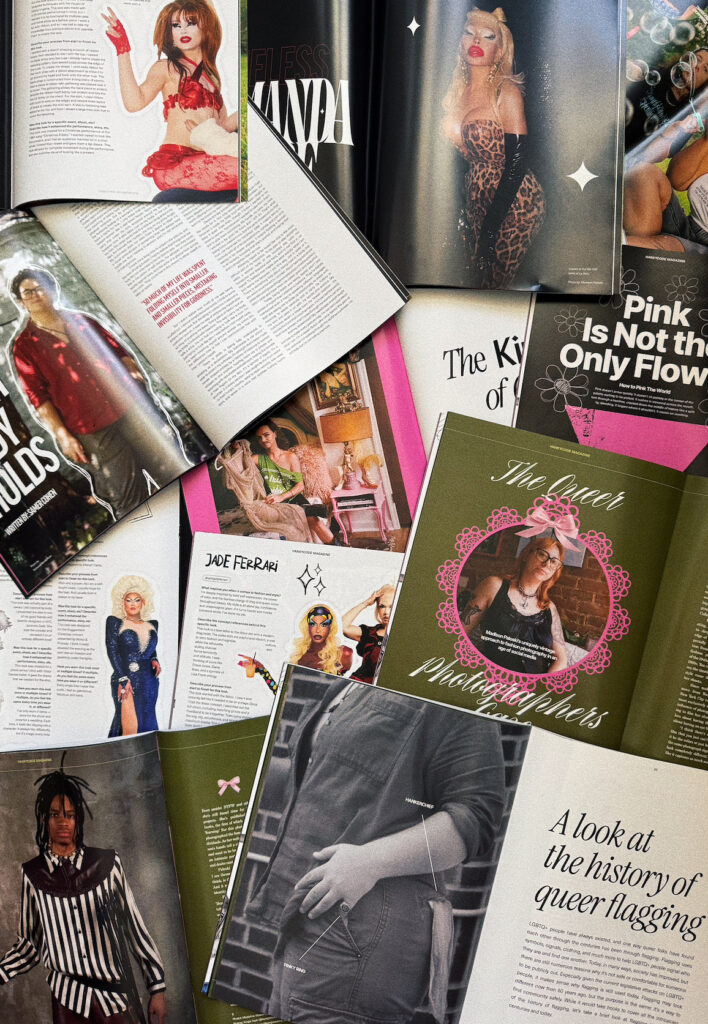
Hankycode is a queer magazine cofounded by Ferris and Torch alumnae.
2022 journalism and technical communication graduate, Rebecca Vanderkoi, who is the publications Editor-in-Chief, and 2023 design graduate, Sienna Parmelee, the publications creative director. Hankycode focuses on queer history and gets its name from the mid-19th century, when members of the queer community would wear hankerchiefs in their back pockets using different colors and styles to communicate their identities and desires.
Why did you decide to focus on a magazine publication?
Parmelee
Right now, there’s been a resurgence in print media. It’s such a huge portion of our history, especially queer history, that is queer magazines and queer zines. That was often the only way you could have access to any of this queer content. We have a need for both the digital and physical archive of queer history and queer content. I also think that we’re in a time when artificial intelligence is taking so many people’s jobs, it’s being used more and more to generate creative assets and written assets. It’s estimated that over 90% of what you see on the internet now is generated by AI, which is very sad and devastating. I know that some people might have different opinions but I am a graphic designer and Rebbeca is a writer. Print allows us to do something that AI cannot replicate. AI might be able to write the content or do the design, maybe even give you the file, but they can’t print it and get it in somebody’s hands. AI cannot put the love and care that we put into our magazine. That’s something that only humans are able to do.
Vanderkoi
There’s something so important about having a physical thing to hold. Especially when history is trying to be erased, it’s kind of a way to push back against that. We focus on both the print and the digital publication, so there won’t be a way to erase this. Once our content is printed, someone can’t change it and go back to make it say something it didn’t before. Even if our physical print media gets lost or something happens to it, we will always have that digital archive to fall back on.
How did the idea of Hankycode start and how long did it take to get things off the ground and running?
Parmelee
Rebecca and I are no strangers to creative partnerships, particularly with each other. I mean, this is so full circle, we met at the torch, working on the paper together. I worked as production manager and Rebecca was the opinions editor. I would come to her with layout ideas and she was always my favorite to work with, even at the Torch. We worked so well together that we even decided to write and direct a short film that we did shoot and hold auditions for, even though that idea eventually got trashed. It was a good experience for us to learn how to work with one another. So when Rebecca came to me and said that she wanted to make a full publication. She asked if I could help her with the layout. I told her I would only help if I got to be fully involved. I told her I was more than happy to help her with the layout, but I want to be fully a part of this as well, because I believed in it so much.
Vanderkoi
In 2023, I began a small Substack under a different name that would eventually become Hankycode. During that time, I started to play around with the idea of what I wanted it to be. I asked myself, what do I want this to be? What do I want to be writing about? And that’s when I settled on queer history, especially in the context of where we are today. I wanted to spotlight queer artists, especially artists who maybe weren’t getting that attention that I think they deserve in other publications. So it began as that under my old substack, Sienna and I collaborated on a one-time little zine. Then Trump was elected again and it was kind of that big push for me. I had been mulling over what I wanted to do. But then, when he was elected, I was just so angry and I wanted to do something. I knew that starting a publication or a magazine wasn’t going to change the world, but I felt like it was one small thing that I could do with the skills that I had. At that point, I reached out to Sienna and we started collaborating fully. We worked together every day to develop exactly what we wanted this to look like.
How many people are on the team?
Parmelee
Depends. We have a steady volunteer team of about eight people. Outside of that, we have a team of about 13 writers that we send monthly calls to. Everyone who writes to us and regularly submits gets put on our email list, where we send out things that are happening during the month, as well as any important stories that we might want to tell. We also let them know that they can pitch anything they want to us at any time, or if we need to reach out to somebody for them to get a Q&A or feature going. We always end our emails with a reminder of our zero AI policy. We want to make sure that anybody we’re enlisting to help us with stuff is following that.
Vanderkoi
We also have a volunteer team that helps out with specific things. I work closely with our writers and very much appreciate all of their pitches. Originally, I had been writing everything and I knew that doing that wasn’t sustainable, especially if we wanted to put out more content.
How do you decide what makes a good story?
Parmelee
I would say that we’re very much at the intersection of queer art, history and culture. What I like to say is that we’re a soapbox, not a megaphone. So we’re not necessarily shouting things at people or getting them to believe something or someone in particular, but we are here to lift somebody else to that platform. Even though we are small now, we are continuously growing. That’s sort of our approach when we’re working with artists; sometimes we snag bigger artists and in that case, they’re working for us. When we’re working on historical or culture-based pieces, we always want to draw them back to history. One of my favorite articles and one of our top-performing ones was an article about the Skims bush and how that connects back to queer history and how it’s actually an appropriation of queer history. Which is something that people don’t often think about. I think stories like that really encapsulate how we like to approach pop culture, bridging those topics back to our history.
Vanderkoi
The biggest thing once we figured out what we wanted our beat to be, was figuring out what separates us from other queer publications. There’s plenty of queer publications out there, but what makes us different is our historical angle. Aside from the historical angle, I knew that I wanted this publication to be full of queer artists, especially those that we don’t see in a lot of other media. Anything that falls under these things is inevitably going to be something we want to see. As we grow, we are exploring other types of content such as poems and personal essays. As long as it falls under the umbrella and is related to queerness, we will run with it. In terms of what I send out each month, I send out a long list of exactly what we’re looking for. Other than that, I try to keep it relativly open ended. Something I typically do is look at a calendar to see what’s going on. For example, last week was lesbian visibility week, so I added that pitch to the email and said, “Hey, anything related to this would be great.” I also try to look and see if there are any other holidays or historical anniversaries, since we like to highlight those as well. We are also trying to branch out and cover a little bit more news and culture-related things.
Can you share anything regarding plans for the future of Hankycode and upcoming projects?
Parmelee
We have our third print edition coming out on June 14, which will be a big pride edition with a lot of really exciting artists, with a mix of bigger and smaller names. We are also working on a rebrand and a new website right now. When we first started, we were just so mad and wanted to get this out there. We worked super quickly, getting everything out. Now, we have the time to look back on what’s working and what isn’t working. We’ve also been able to figure out what is missing from our brand and how we can differentiate ourselves more in this market. We should have a new merch collection coming out in June as well. We post a lot on our social media for anyone who wants to stay in the loop with what we’re doing.
Hankycode is open 24/7 for submissions for anyone who wants to submit a pitch or idea. It is recommended that anyone looking to get involved also share example writing work. From there, if you are a good fit for the team, you will be added to their monthly email list.