
The Ferris Theater Department took the Williams Auditorium stage for its first show of the 2025-26 school year with “Welcome to the Monkey House,” which featured four short stories acted out entirely by students.
The production is a screenplay adaptation of Vonnegut’s “Welcome to the Monkey House.” The four stories featured on stage explore themes of technology, conformity and human connection, topics that continue to resonate more than half a century after Vonnegut first wrote them.
The four stories reflect Vonnegut’s lifelong concern with humanity’s moral balance in an age of progress. From government overreach in the opening play “Harrison Bergeron,” to emotional vulnerability in “Who Am I This Time?”, the false promise of technology in “The Euphio Question” and redemption through empathy in “The Kid Nobody Could Handle,” each warns against humans losing their compassion amid modern advancement.
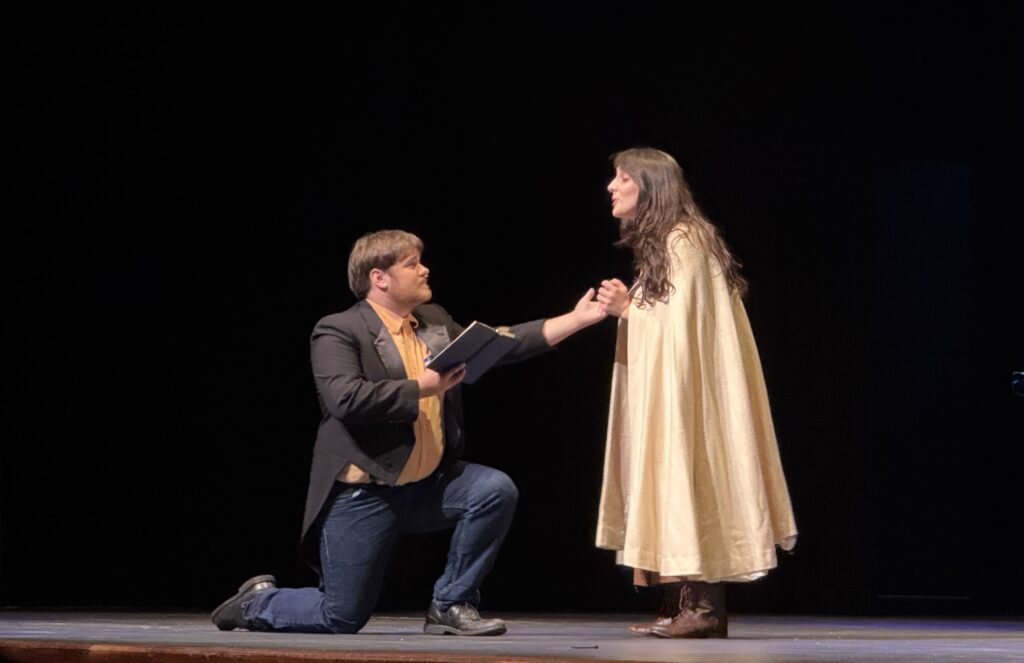
This Time?” Photo by: Blase Gapinski | Editor in Chief
Theater director and assistant professor of humanities Dennis Henry was hoping the audience would be able to walk away from the show reflecting both on the humor and humanity within Vonnegut’s work.
“A big part of Vonnegut’s writing was about the dangers of modern weapons, the dangers of modern technology, and the importance of having empathy for other human beings,” Henry said. “I think we get a lot of that in this play.”
The audience filled the auditorium for opening night, responding with laughter and applause as each story unfolded on stage.
Henry described what it was like directing a show as intricate as “Welcome to the Monkey House” and where the inspiration came from.
“Because there are no theater majors, we only have time to do one play a semester, so to accommodate as many people as possible, I try to look for a big cast, usually between 25 and 35, and we had 29 students in our cast here,” Henry said. “The other things we have to look for is whether there are enough roles for women, so we have to consider gender balance. Apart from that, we’re looking for things that are fun to do, that are interesting and that maybe have something to say about modern society.”
Henry’s message about empathy and human connection wasn’t just something explored on stage as it was something the cast felt deeply behind the scenes.
Integrative studies senior and Alpha Si Omega community liaison Jordan Bos, who performed in “The Euphio Question,” said the unique structure of the production helped the cast grow closer.
“At first, we were all separated into smaller story groups, but once tech week starts, we’re all together,” Bos said. “That’s when it gets more fun, and you really get to know everyone. That’s what I love about theater. It’s a community.”
In “The Euphio Question,” Bos played the wife of a sociology professor who helped create a machine that emits euphoric waves, sending the entire town into a blissful, trance-like state. She mentioned how the audience plays a part in shaping the role she is in.
“Honestly, hearing the audience laugh helps me stay in character,” Bos said. “It’s like method acting and it just keeps me smiling.”
Bos said the story’s message felt timely, reminding audiences of the importance of balance and emotion in a world increasingly drawn to instant gratification.
“It’s okay to be happy, but not all the time,” Bos said. “Emotions is important and it’s okay to feel sad or angry too.”
General business sophomore Imogen Hill also found joy in the camaraderie of the cast coming together for the first time and said the experience was just as much about personal growth. Hill played Helene Shaw in “Who Am I This Time?”, a reserved woman whose life changes when she’s encouraged to join a local community theater in the town of North Crawford.
“When Helene first starts acting, she’s terrible,” Hill said. “But once she opens up emotionally, she completely transforms. She referred herself as being trapped in big glass bottle, and by the end, she’s finally out of it, becoming happy, expressive and the person she wants to be.”
Hill said working on the show helped her connect more deeply with her character and her fellow castmates. Because rehearsals were divided by story, she didn’t see the full scope of the production until tech week.
“It was exciting, but also a little nerve-wracking, because we hadn’t all been together before,” Hill said. “But once I saw the show as a whole, I really understood it more and it made so much more sense. Everyone coming together helped me immerse myself into my character because everyone else was too.”
Through their dedication and teamwork, the cast brought Vonnegut’s message of empathy and humanity to life on the Williams Auditorium stage.
The Ferris Theater Department will return to the stage in the spring semester with “The Guy Who Didn’t Like Musicals,” a dark comedy about a world where song and dance take over everyday life.