
Every month, the university holds an Academic Senate meeting to ensure that academics across campus run smoothly, and this month’s session on Nov. 4 focused on key updates ranging from curriculum changes to faculty concerns about a potential classroom resource.
The academic senate serves as the primary forum for faculty and administrators to raise issues, review proposals and make recommendations that shape the university’s academic policies. There are around 40 members who make up the senate and consist of faculty who vary across the different departments on campus.
The meeting consisted of updates relating to ongoing curriculum revisions and explored a resource option that has become available to students at the university through the Disability and Accessibility Resource Center (DARC), which aims to assist students with taking notes in the classroom through audio transcription.
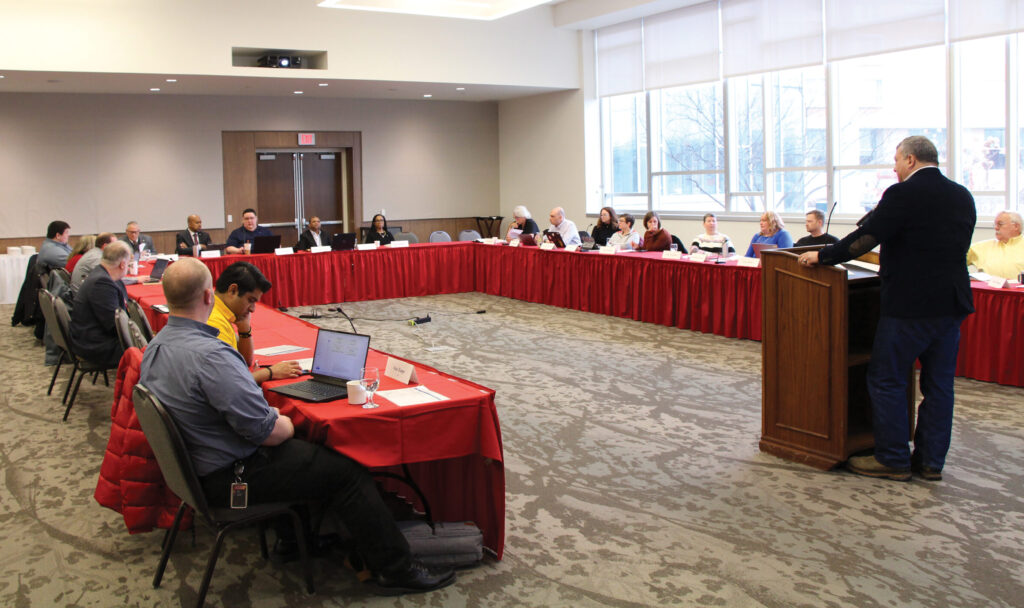
The presentation of the new audio transcription tool raised questions among faculty about privacy and control in the classroom. Some expressed concern over how recorded lectures might be shared or used outside the intended academic setting, especially if uploaded to platforms without the professor’s knowledge or consent.
Chair of Ferris’ Interdisciplinary Studies department, Kristin Conley, has just started serving on the Academic Senate and has attended the last several meetings. As both a department chair and faculty representative, she expressed how important it is for the faculty of the school to have a voice, especially in instances where there may be changes to the classroom environment.
“We’re a community. We need to be getting involved in taking care of each other, because this is our university,” Conley said. “We have to do the work to make it a better place. Not only for our students, but we try to make it a better place for us as faculty, too.”
Conley mentioned how with her department, University College, it is rather small so being able to have that voice on the Senate is crucial to making sure that they are represented across campus.
She described how since she has started serving in the Senate, it has shown her how important shared governance is to keeping the community and university strong. For her, the work is about connection and collaboration, not just procedure.
“If I want change, then I am going to help make sure it gets done and work to make sure it gets better,” Conley said. “In my mind, you can’t complain if you aren’t going to do the work and if you don’t like something, then there’s probably something you could do to help support making it a little bit better for yourself or the people that are around you, who maybe you don’t feel like it’s going well for.”
Conley said she hopes to see continued collaboration among faculty and administrators as the Senate moves forward.
Associate Professor of Public Health and President Emmanuel Jadhav offers an in-depth exploration of the Senate’s structure, responsibilities, and ongoing initiatives. One of the main things the Academic Senate does is examine the college landscape, observe how it has shifted and implement changes to ensure academics are meeting industry standards, preparing students for graduation.
“We accept that the way students do college now is very different from 20 years ago, or even 30 years ago and even 10 years ago. Almost everybody has a job that they are working five days a week, or sometimes seven days a week,” Jadhav said. “There might be family responsibilities, personal responsibilities and all of this comes together and conflates with each other. So I think we try to be very intentional, to kind of create that space where we can have that impact on the student experience and we can bring them into how we make changes and really help influence what they do.”
As the Academic Senate looks ahead, some of its focus will turn toward shaping the future of academic programs at Ferris. Among the initiatives under review is the development of reduced-credit degree options, a move that could make earning a degree more flexible and affordable for students without compromising academic quality.
Jadhav said the Senate is working to finalize clear guidelines in line with new Higher Learning Commission standards, ensuring that any proposed programs uphold the same rigor and learning outcomes as traditional degrees. With a process already being in place and it not needing to be redesigned,
“We want to make sure that no one who wishes to have a voice in this process is denied that opportunity. Our goal is to move forward thoughtfully, nothing will be presented that’s half-baked or lacking input from faculty, students and other stakeholders,” Jadhav said. At the end of the day, it’s the faculty who have to run these programs and it has to be students who like the programs or want those programs. If the students don’t want it, the faculty don’t like it, it’s a recipe for failure.”
The Academic Senate will continue to hold important discussions at its next meeting, scheduled for Tuesday, Dec. 2, at 10 a.m. in the DEC ballroom. During this session, the Senate will also take time to acknowledge and celebrate student success stories, highlighting the achievements that make Ferris a thriving academic community.