
Ferris State University is gaining national attention beyond the football field, with its astronomy program earning recognition for research now included in one of the world’s most authoritative scientific catalogs.
The recognition comes from a binary star research project that resulted in newly developed orbital models being adopted by the United States Naval Observatory, making a rare achievement for a primarily undergraduate institution. The project highlights Ferris State’s growing role in national scientific research, demonstrating how undergraduate-focused institutions can contribute meaningful data to global astronomy efforts while giving students hands-on experience typically reserved for major research universities.
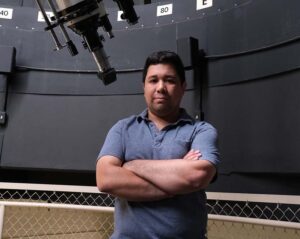
Physics and astronomy professor Dr. Dinesh Shetty shared more about the adoption by the U.S. Naval Observatory and how it underscores the significance of their work.
“What makes this work especially noteworthy is that four of the newly developed orbital models have been officially adopted by the United States Naval Observatory,” Shetty said. “The USNO’s visual binary star catalog is the world’s authoritative reference for binary star orbits and is used by astronomers internationally. Once included, these results become part of the permanent scientific record, ensuring that observations made at Ferris State will continue to inform astronomical research for years to come. It is uncommon for work conducted at a primarily undergraduate institution to be incorporated into such a major global reference.”
Shetty emphasized that the student involvement was a central part of the project.
“Just as significant, the project included direct student involvement,” Shetty said. “Having a Ferris student’s name associated with research that enters one of astronomy’s most important catalogs is a rare achievement and highlights the authenticity and rigor of the research experience.”
He added that the project reflects a broader shift in how astronomical research is conducted.
“Beyond the scientific results, this work demonstrates the growing role of undergraduate-accessible observatories in modern astronomy,” Shetty said. “By integrating student participation with contemporary observing techniques, smaller observatories can make meaningful contributions that complement large national and international survey projects. This approach broadens access to research, supports workforce development in STEM fields, and shows that impactful scientific discovery can happen well beyond traditional research powerhouses.”
Ferris State undergraduate Francisco Vasquez, who participated directly in the research, said the experience was transformative both academically and professionally.
“Being an undergraduate student played a fundamental role in this work. It allowed me to engage directly in real research, using authentic observational data and scientific methods applied in professional astronomy,” Vasquez said. “I also received guidance and mentorship from Professor Dinesh Shetty, from the Department of Physics and Astronomy, who supported and guided every step of the project. I would also like to thank the Ferris State Office of Research for providing resources, institutional support, and opportunities that made this research experience possible.”
Vasquez gave insight as to why updating these research models are particularly important for the field of astronomy.
“Updating orbital models of binary stars is crucial because these systems allow us to directly measure stellar masses, which is one of the most important properties of stars,” Vasquez said. “With more recent and precise data, the models become more reliable, improving our understanding of how stars evolve, how they interact gravitationally, and how they behave in different environments across the universe. Additionally, updated models help correct errors accumulated from older observations.”
He also described the opportunity to work with one of the world’s most famous telescopes.
“Something that truly blew my mind and felt out of this world was having the opportunity to work with, observe, and operate the 100-inch telescope at Mount Wilson, an instrument of enormous scale that very few people get to use,” Vasquez said. “Being able to see how data is collected directly from such a historic telescope, adjust its controls, and observe binary stars firsthand was an incredible experience.”
Vasquez said the site’s history made the experience even more meaningful.
“Additionally, Mount Wilson is a historic place where even Albert Einstein worked and conducted research, which makes the experience even more extraordinary,” Vasquez said. “It not only allowed me to connect theory with practice, but also gave me a unique sense of contributing to professional astronomy, operating equipment that has been fundamental to many historic discoveries in science.”
Vasquez hopes the research inspires others to explore the field.
“A key message I would like to share is that astronomy allows us to explore and understand how the universe works,” Vasquez said. “It helps us understand how galaxies are formed and structured, how our solar system is organized, how celestial bodies move in their orbits, and how stars and other objects behave in the vastness of the cosmos. Essentially, astronomy gives us the tools to appreciate the patterns, laws, and beauty that govern everything we see in the universe.”
Ferris State’s expanding role in national scientific research while giving undergraduate students hands-on experience that directly contributes to the global understanding of the universe. The work demonstrates that impactful astronomical discovery can take place far beyond traditional research powerhouses.