
On March 21, the seventh rendition of the Crimson Clash tournament was hosted by the Ferris State Smash team, bringing hundreds of high school and college students to the Center for Virtual Learning.
Each year, this competition brings together some of the best Super Smash Bros. Ultimate players at the high school and collegiate level. The all-day event featured five Super Smash Bros. Ultimate events, one of which was a partnered-based doubles tournament and it also included two single events featuring Street Fighter 6 and Super Smash Bros. Brawl.
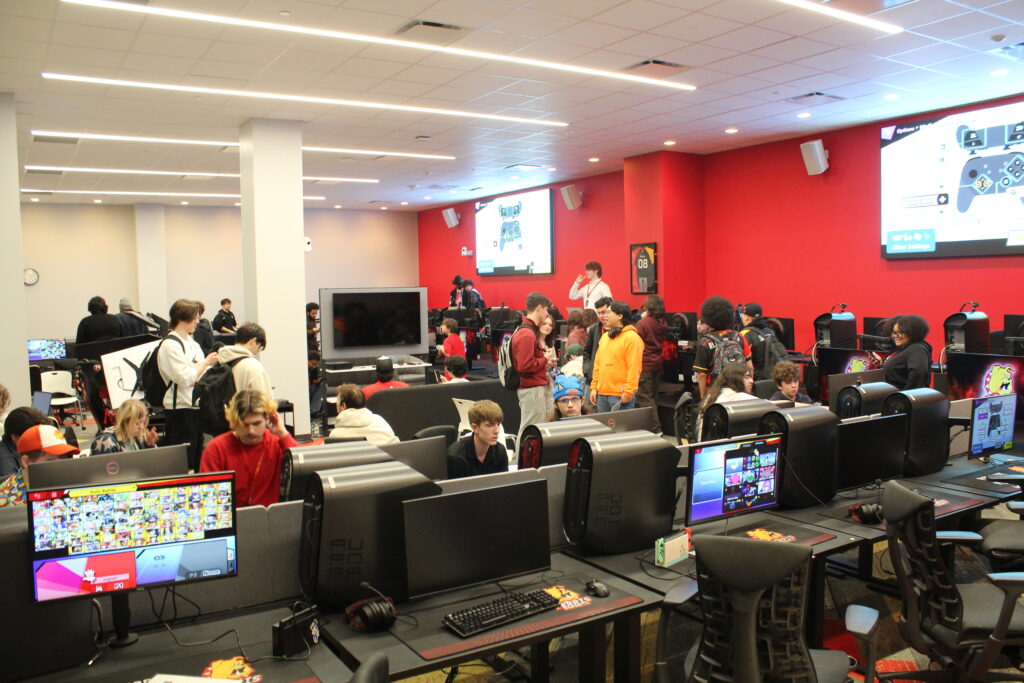
The entry fee was $5 for all events. The money all went into the larger pot and with over 150 competitors registered and a $250 pot bonus included, the total was close to $1,000. The top eight competitors split the combined pot, with first place taking home the largest share.
The high schoolers kicked things off with their dedicated singles bracket beginning at 9:30 a.m. Competitors traveled from all over to make the tournament, featuring esports athletes from Davenport University, Michigan State University, Grand Valley State University, Saginaw Valley State University and Northwestern Michigan College. Each event was open entry as well, so anyone willing to pay the entry fee had the opportunity to compete
The competitions that received the most attention were the Super Smash Bros. Ultimate Squad Strike event and four singles pools of single tournaments, with Squad Strike taking place at noon and the Ultimate pools kicking off at 2 p.m.
Varsity esports captain Nathan Biggs highlighted the annual competition and why it is beneficial to the broader campus. He mentioned that bringing these high schools and other universities to the campus continues to put Ferris’ name out there and show the mid-Michigan community the vast resources the school has to offer.
“We have eight commentators this time who are all from different regions of Michigan and they come in here and they commentate the game,” Biggs said. “It’s nice to have that overlap of people that normally you wouldn’t see in the same scene. Even having the younger people who are getting in and coming to Ferris to play some Smash Ultimate [Super Smash Bros. Ultimate], see the campus and I think it’s pretty good for the administration in that way too.”
The $5 venue fee competitors pay goes entirely to the club at Ferris. This helps the event run and allows them to pay their commentators and production team. Overall, it is a net even event for the esports team.
Biggs spoke on the level of competition that is brought out for the tournament. Numerous competitors are currently ranked in the top 15 in the state of Michigan, and the number one and two-ranked players were also in attendance.
“It’s just really nice to see this esports space get used to its full potential and have so many people here who are enthusiastic about this game that has been out for nine years,” Biggs said. “In the modern scale of esports, there aren’t as many local area network tournaments, and I’ve played a little bit competitively in some other Esports, and it’s really nice to be able to see your competitor next to you. Smash builds community like nothing else because it is a grassroots scene. It isn’t funded by any corporation, it’s just all of us going to an event for the game we love.”
Esports Coordinator Justin Summe guides the entirety of the esports program at Ferris. He manages and helps set up events like the Crimson Clash, while also working on the production behind the scenes. Another thing he does is visit high schools to recruit students to partake in esports at Ferris.
“Generally, we have a lot of events going on here. So far this semester, we have had around five big ones,” Summe said. “So much goes into coordinating the teams, the equipment and the logistics in terms of planning and getting everyone here.”
Summe, who has been at Ferris for about a year, explained how much time and effort the students have put into making sure the event is successful. The Smash team works closely with him to share their vision for the event, and he is there to help guide them and execute the plan.
He mentioned the importance of esports and how it brings the community together in a way that people typically wouldn’t associate with video games.
“Playing online is great. Having video games as a competitive outlet is great, but when you are in person, it changes the entire field of the community side of things,” Summe said. “It is super important for socialization, and at times, video games can be somewhat isolating, but when you come to something like this, and you see 150 to 200 people all together, celebrating the same thing, hanging out, exchanging ideas, and generally sharing their hobby, it becomes very apparent what the value of esports is.”
Senior in digital animation and game design, Nicholas Tidwell, explained how big this event actually is for the esports community here at Ferris. It is the largest event that the Smash team has hosted for the Northern Michigan region since 2019.
“By having this really big tournament in this region, it’ll not only encourage more tournament hosts to make big tournaments, but also will encourage other people to go to those big tournaments,” Tidwell said. “Overall, I think, very good for the community and just overall very good for our region.”
Ferris State University will host the Collegiate Fighting Games Conference national tournament on April 17–19, bringing top collegiate competitors together for titles including Street Fighter, Tekken, 2XKO, Guilty Gear and other traditional fighting games. The community can expect a high-production, in-person esports experience featuring live broadcasts, professional streaming setups and a vibrant, social atmosphere where students and visitors can connect around their shared passion for competitive gaming.