
On Tuesday, April 21, and Thursday, April 23, there were town hall meetings aimed at the potential reform of General Education and determining the future of the curriculum.
The first meetings were held on Tuesday, April 21, with the first being held at 11 a.m. for students only, and a faculty-only meeting that was scheduled for 5 p.m. the same day. Thursday’s meeting was open to both students and faculty and acted as a way for everyone in attendance to converse and share their thoughts.
The General Education Reduced Credit Task Force presented a proposal at these meetings, created by Rusty Leonard, Katie Kalata, Paige Young, Leslie Sukup and Michele Harvey. This proposal highlighted how the reform would be implemented. Currently, students of all colleges are required to take 41 to 47 credits of General Education to satisfy the requirement. The new proposal that is being discussed by the RCT would require students to take only 30 credits of Gen Ed credits.
Paige Young, Photography Professor and chair of the task force, explained the process of bringing this proposal to the JCGE from its members.
“There were three proposals that were brought to the table, however, the committee voted to not extend our charge or the deadline of our committee beyond the charge itself, and due to that majority vote, two of the proposals did not make it to the town halls,” Young said.
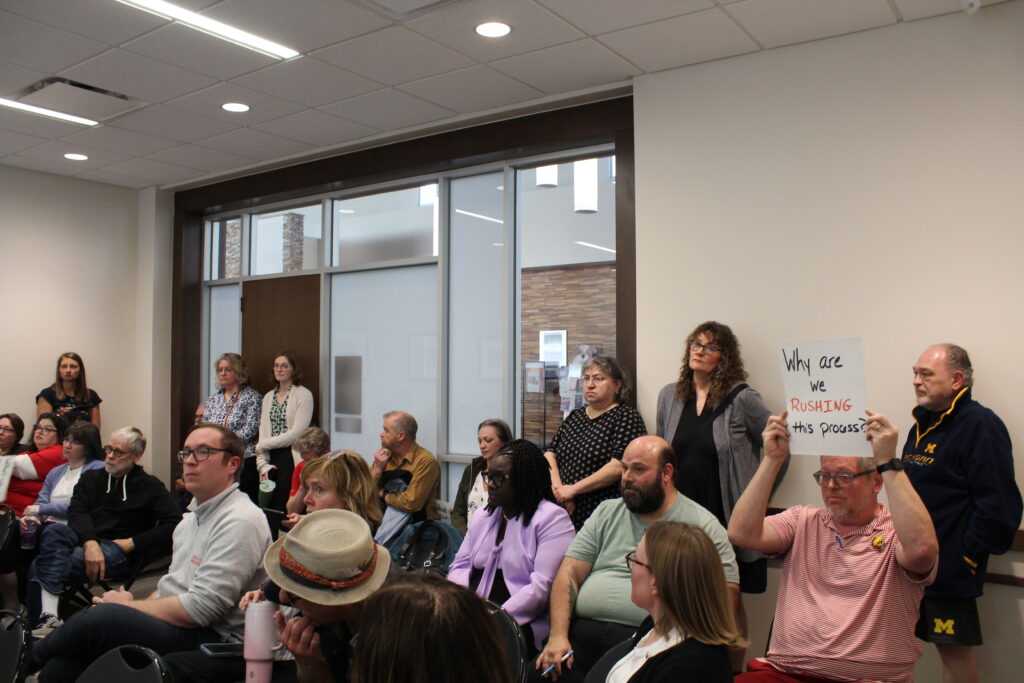
However, the committee’s apparent lack of transparency and disconnect between research methods and best practices for curriculum revision have left faculty members flustered. Some faculty members even made signs that they held, pushing back against the proposal.
Professor in the ELWL department and director of the writing center, David Marquard, discussed the lack of transparency that he and many faculty members have expressed about this proposal.
“It’s about the process and how backwards, non-transparent, non-collaborative, non-communicative and rushed. We’re in April, and we’re just now getting this proposal,” Marquard said. “We’ve kind of heard wind of it, and we were ready, but we couldn’t get actual solid answers, so it’s really just been shady from the beginning.”
Victor Piercy, the director of the Honors Program at Ferris State and former director of General Education, was also in attendance at the town hall meeting exclusively for faculty.
“There are a lot of open-ended questions, and that means it’s going to take time for faculty to fill [the survey] out, and it’s going to take time to evaluate, because you need to do qualitative coding to really get any useful information out of a survey like that,” Pierecy said. “I just want to mention that I believe everybody involved truly has the students at the center of their thoughts, and we’re arguing so fiercely because we all care so much.”
Having joined the Academic Senate in time to vote on the 2013 general education recommendations, Piercy brings both historical perspective and administrative experience to the current debate over proposed changes.
Not only are faculty concerned with this proposal. A Ferris alumnus attended the meeting and shared a story via the Zoom chat feature about how some of the General Education courses landed them a starting position out of college.
One of those is Sara Walker, who is an alumna of Ferris State’s welding engineering technology program and a graduate of the M.S. in career and technical education program. She directly credits a history course that she took at Ferris as to how she landed a position with a $70,000 starting salary, with FANUC America Corporation, for a welding engineering role.
“In that history class, my professor invited me to attend a dinner with the visiting Ambassador of South Korea. During my interview, I shared that experience with FANUC, a Japan-headquartered company,” Walker said. “Their HR team told me it was rare to meet a technical graduate with both technical skills and cultural curiosity. I would not have pursued that kind of opportunity without my history professor’s encouragement, and it became a deciding factor in my hiring.”
Walker described how this course directly influenced her worldview and her commitments to moral and ethical practices within her field.
“That history course also strengthened my understanding of how knowledge is created and shared through primary and secondary sources,” Walker said. “It sparked a lasting commitment to accuracy that has shaped my integrity as an engineer and supported my graduate studies. I have personally experienced higher pay, better job placement and better relationships with my coworkers as a result of the gen ed courses I took at Ferris. I want our future graduates to have the same opportunities that I benefited from. These classes add value to our degrees.”
Some other faculty members also expressed concerns regarding the survey that was put out at the end of each presentation. Students and faculty members were sent the survey on Tuesday, April 21, around 11:40 a.m. and were asked to complete it by Friday, April 24, at noon.
Coordinator of Political Science offerings at Ferris, David Takitaki, discussed some of the concerns he brought up to the committee about the survey that was sent out.
“I have serious misgivings about the survey, and I actually made those known to the committee as soon as I took it,” Takitaki said. “The first point was that there is exactly one piece of what we would consider to be quantitative data in that survey, it is the first question and the thing it measures has nothing to do with the proposal. There were a few other things I pointed out, as there are things that are written in the qualitative responses, that, to me, as a political scientist, there were elements of that survey that I found to be pretty nakedly designed to effectively push support for the proposal as it is written.”
Professor of art history in the humanities department, Rachel Foulk, attended the town hall meeting scheduled for faculty only and addressed her concerns with the proposal. One of the things she highlighted was how she was concerned about students
“I’m really surprised by the proposal that was presented. I think it really undermines the work of general education, the strong foundation that General Education provides in areas like writing, communication, mathematics, culture, self and society and diversity in some way,” Foulk said. “Each of those is cut in the proposal, and the reasoning for why we would be cutting doesn’t make sense to me. I think we have to talk about what the purpose of Gen Ed is. What does it help our students to learn? What kind of foundation does it give them in their academic careers and in their careers that they’ll have beyond Ferris, and I didn’t see in the current proposal any convincing evidence for all of the cutting. In fact, I’m very concerned about all of the cutting.”
This issue is ongoing, and the Torch will provide updates via its website.
Nolan Matthews and Gannon Thomas contributed to the reporting of this article.